SuperVoxelGPT: Adaptive and Ordered 3D Tokenization
for Autoregressive Shape Generation
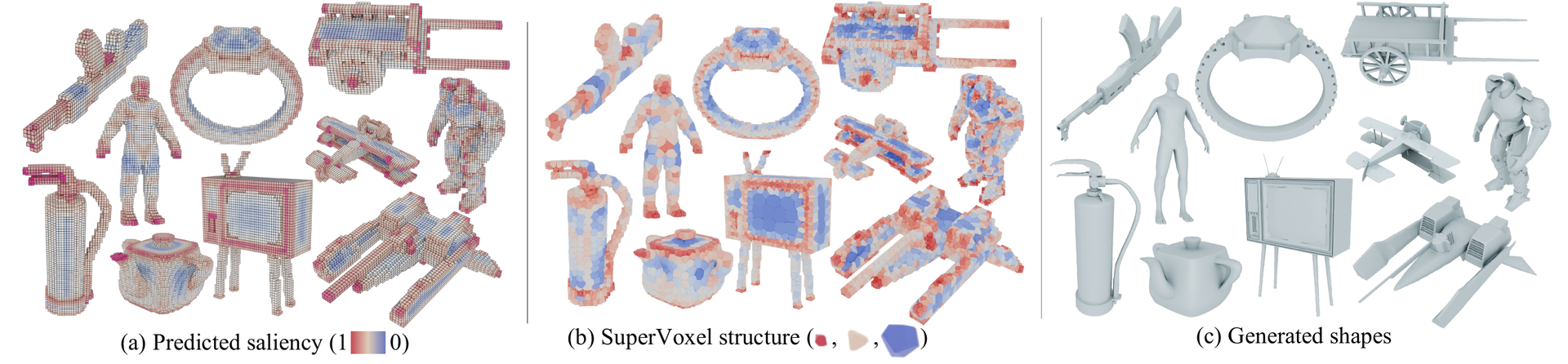
TL;DR — Set-based tokenizers are compact but unordered; voxel grids are ordered but redundant. SuperVoxelGPT resolves the trade-off with a saliency-guided, deterministically ordered supervoxel partition, cutting sequence length to 12.8% of uniform voxel tokenization while matching state-of-the-art quality at full 1024³ — which is what makes high-resolution shape generation fast enough to be practical.
sequence length
over prior methods
at 1024³
per shape
Abstract
Autoregressive multimodal large language models (MLLMs) enable 3D generation but struggle to scale to high-resolution shapes due to inadequate 3D tokenizations. Compact set-based representations discard deterministic spatial ordering, leading to ambiguous sequence prediction, while uniform or octree-based voxel grids preserve ordering at the cost of severe redundancy and excessively long sequences. This structural trade-off limits stable and efficient autoregressive 3D generation.
We present SuperVoxelGPT, a representation-first framework that resolves this tension through adaptive and deterministically ordered supervoxel tokenization. Given a prompt, we first predict a coarse geometric saliency distribution and construct a shape-adaptive supervoxel partition using saliency-guided centroidal Voronoi tessellation, allocating fine-grained cells to complex regions and larger cells to smooth regions. Conditioned on this prompt and ordered supervoxel layout, we introduce a SuperVoxelVAE and fine-tune a pretrained MLLM to autoregressively generate supervoxel tokens.
Experiments using Trellis-500K data show that SuperVoxelGPT reduces token sequence length to 12.8% of uniform voxel tokenization while achieving state-of-the-art generation quality and an average 10× speedup over prior methods.
Method
Inference is three steps. The key move is the order: the token budget is decided before the shape exists — saliency is predicted from the prompt alone, so the partition is available as a conditioning signal rather than something recovered after generation.
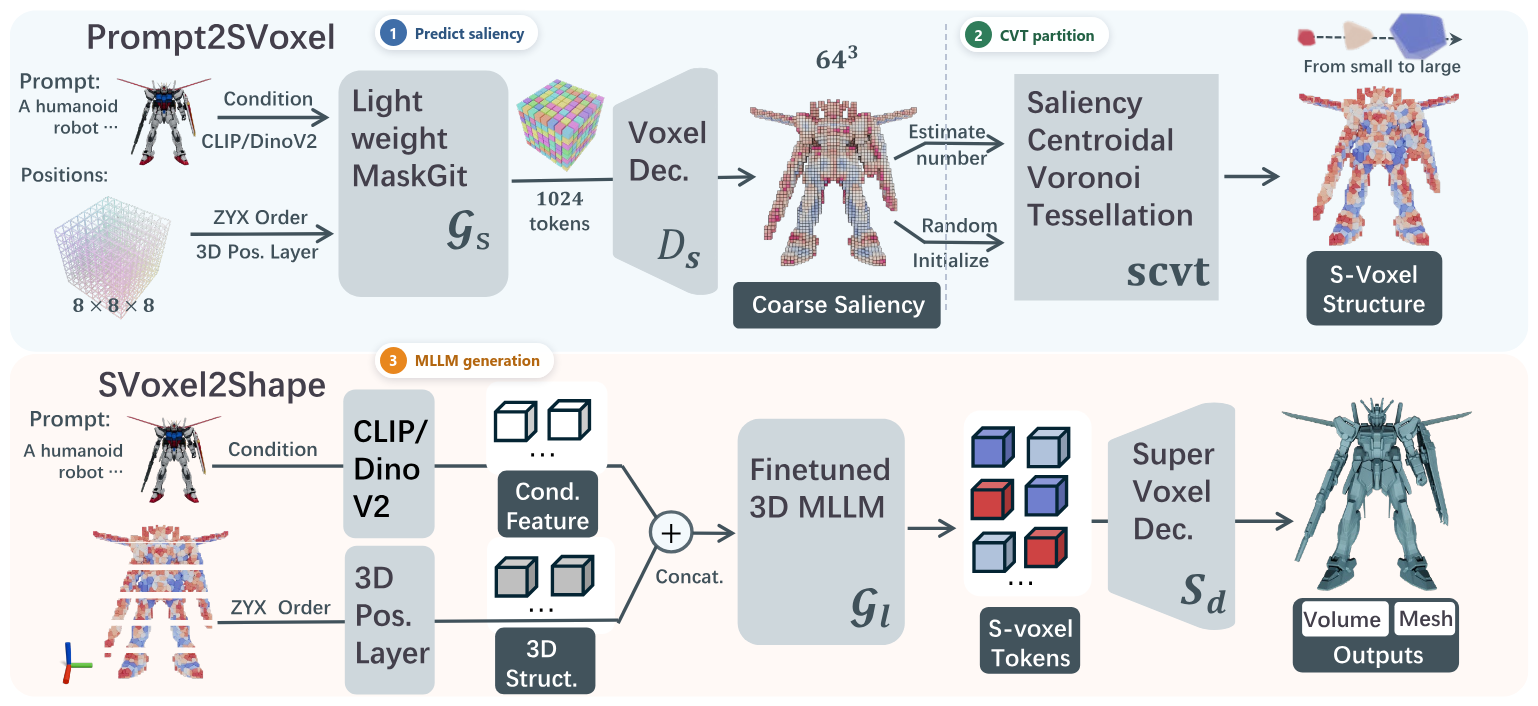
Inference procedure
- Predict saliency. From the prompt alone, before any geometry exists — so the token budget is decided without first having to generate the whole shape.
- Derive the partition by saliency-guided CVT. Centroidal Voronoi tessellation turns that field into supervoxels: dense cells on detailed regions, large cells on smooth ones. Being deterministic, it also fixes a single valid reading order.
- Generate with the MLLM. Conditioned on the prompt and that ordered layout, a pretrained multimodal LLM emits one token per supervoxel, which the SuperVoxelVAE decodes back to geometry — and because the layout is known in advance, decoding runs in parallel.
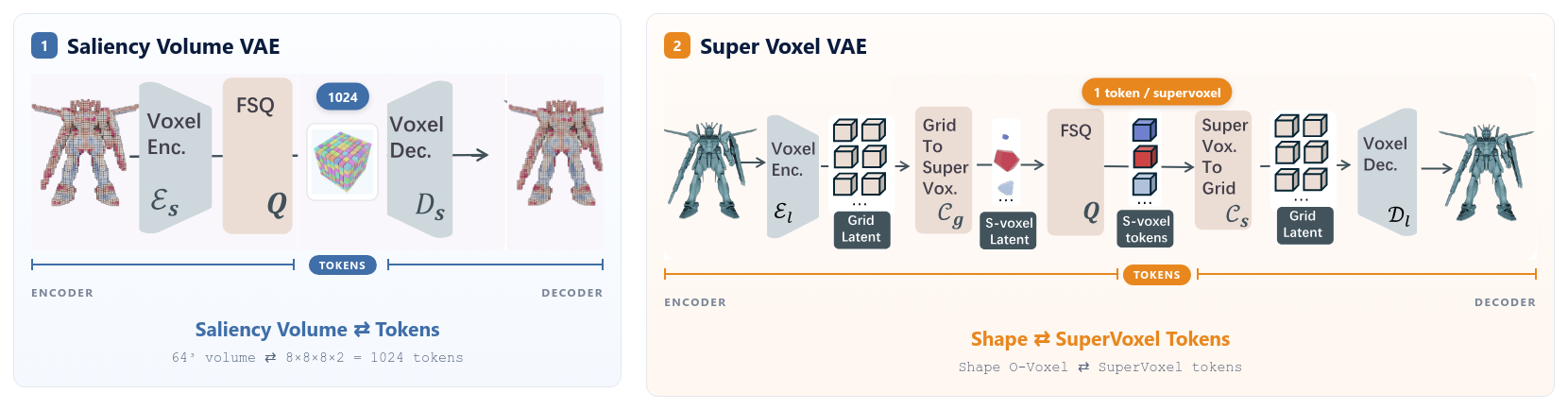
Training procedure
Training has two parts. We first train the two VAEs — the Saliency VQ-VAE and the SuperVoxelVAE — so that each learns its own discrete vocabulary. We then freeze them and train the two generators on top: a MaskGIT that predicts the saliency tokens from the prompt, and a fine-tuned Qwen2.5-0.5B that emits the supervoxel tokens.
Results
Text-to-3D generation
| Method | CDL2 ↓ | PSNR ↑ | ULIP-2 ↑ | MCS ↑ | Time (s) ↓ | Resolution | Tokens ↓ |
|---|---|---|---|---|---|---|---|
| BrickGPT | 0.0851 | 12.99 | 0.199 | 15.39 | 215.5 | 20³ | 179 |
| OctGPT | 0.0797 | 19.80 | 0.329 | 11.74 | 165.8 | 256³ | 47,783 |
| Ours | 0.0134 | 32.05 | 0.469 | 44.19 | 4.48 | 1024³ | 1,065 |
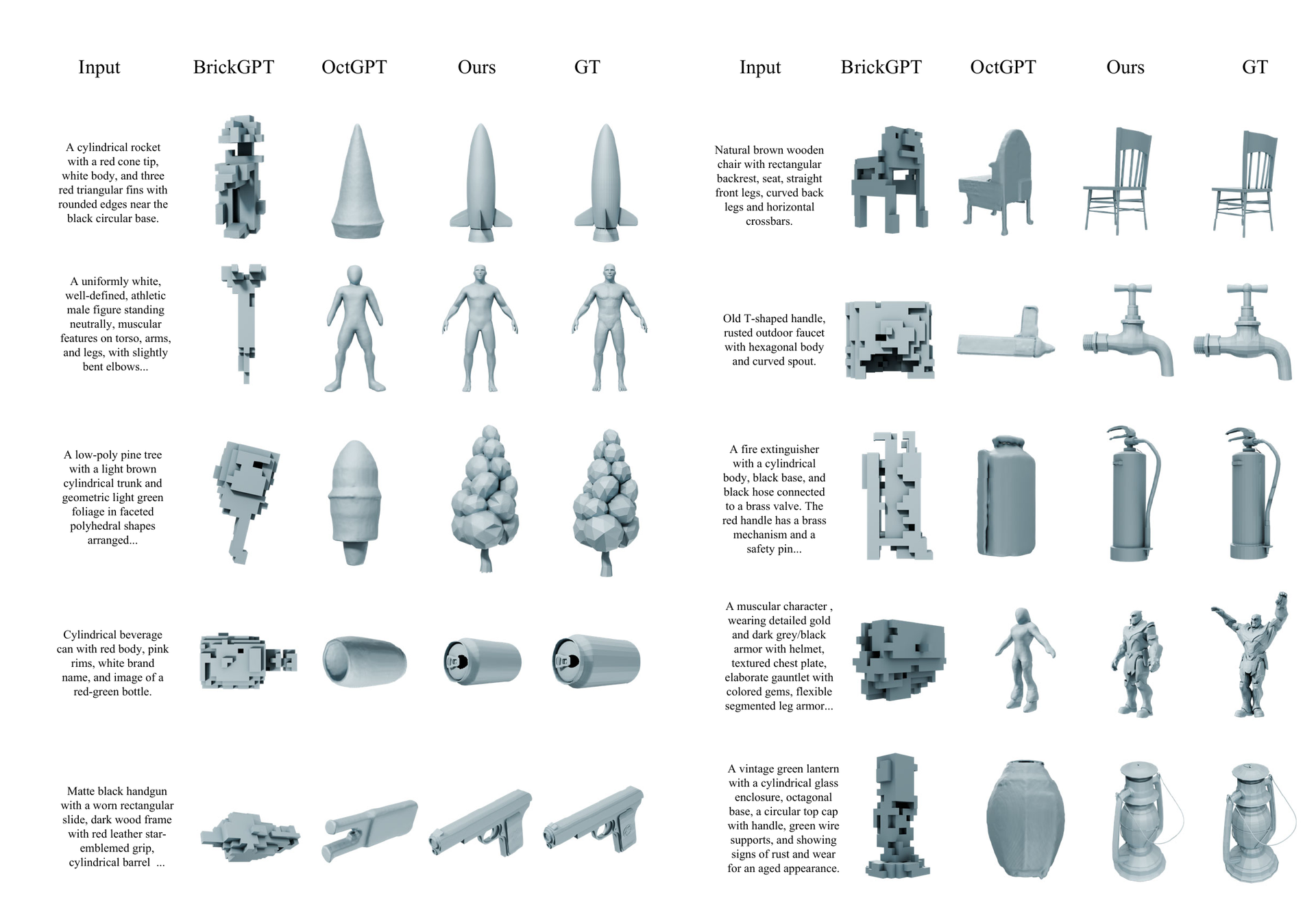
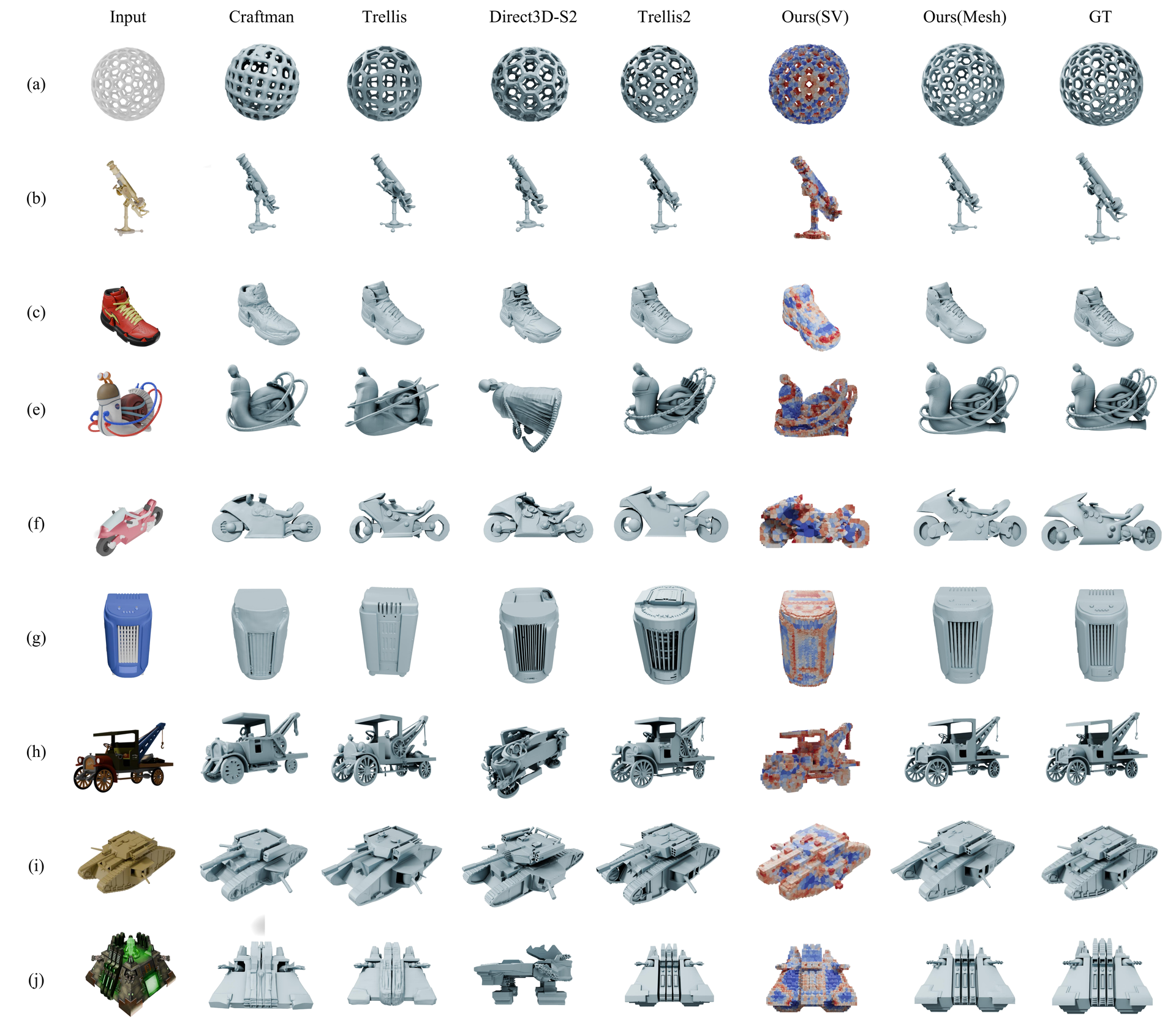
Image-to-3D generation
| Method | CDL2 ↓ | PSNR ↑ | ULIP-2 ↑ | MCS ↑ | Time (s) ↓ | Resolution | Tokens ↓ |
|---|---|---|---|---|---|---|---|
| CraftsMan3D | 0.0252 | 22.90 | 0.448 | 37.85 | 7.92 | 512³ | 2,048 |
| TRELLIS | 0.0182 | 27.28 | 0.464 | 21.64 | 9.03 | 256³ | 8,147 |
| Direct3D-S2 | 0.0168 | 26.14 | 0.461 | 33.17 | 137.20 | 1024³ | 55,420 |
| TRELLIS2 | 0.0123 | 32.19 | 0.475 | 44.24 | 34.25 | 1024³ | 7,303 |
| Ours | 0.0122 | 32.08 | 0.474 | 44.21 | 4.60 | 1024³ | 1,048 |
Ablation
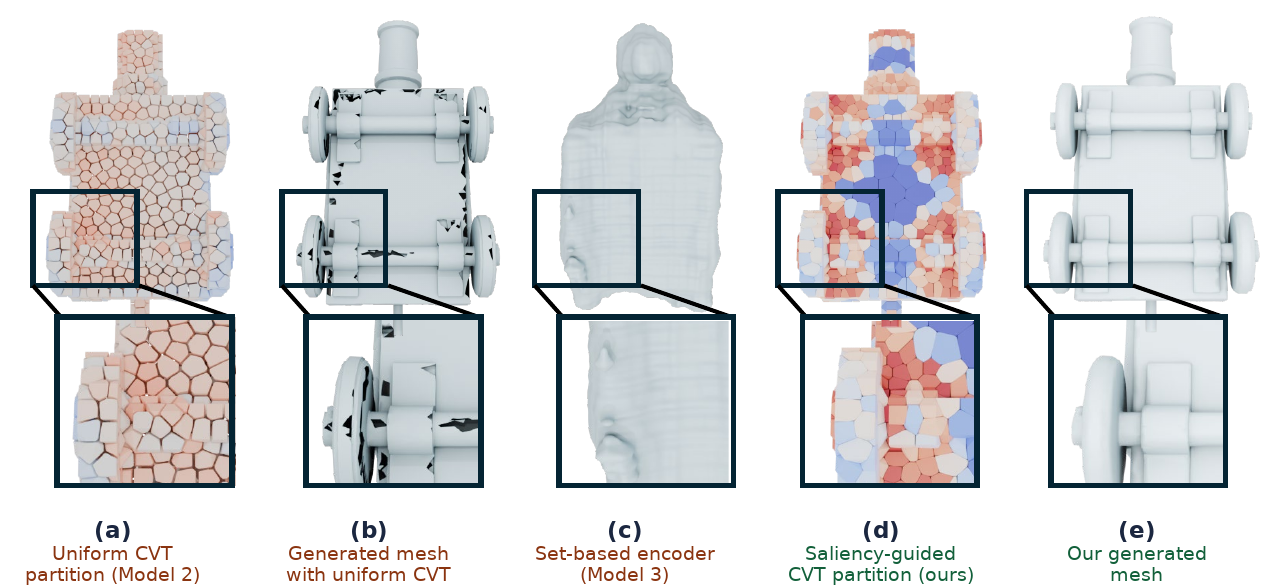
Two design choices are tested separately, each against a variant that removes it while holding everything else fixed.
| Variant | CDL2 ↓ | PSNR ↑ | ULIP-2 ↑ | MCS ↑ |
|---|---|---|---|---|
| Uniform CVT (Model 2 — same budget, no saliency guidance) | 0.0157 | 29.09 | 0.469 | 40.13 |
| CraftsMan3D + FSQ (Model 3 — set-based encoder instead of ours) | 0.0402 | 20.91 | 0.364 | 21.73 |
| Ours | 0.0122 | 32.08 | 0.474 | 44.21 |
Limitations
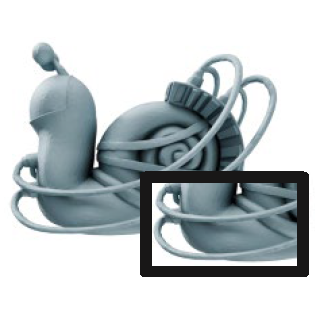
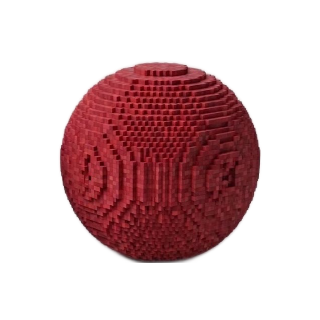
The method's central assumption — that a coarse saliency field predicted before generation is a good guide for where to spend tokens — is also where it breaks down. Two cases are worth stating plainly.



BibTeX
@inproceedings{li2026supervoxelgpt,
  title     = {SuperVoxelGPT: Adaptive and Ordered 3D Tokenization
               for Autoregressive Shape Generation},
  author    = {Li, Yuan and Zhang, Congyi and Gao, Xifeng and Guo, Xiaohu},
  booktitle = {Proceedings of the European Conference on Computer Vision (ECCV)},
  year      = {2026}
}